Why the Microbiome
The World Microbiome Partnership
Advances in science now allow us to better understand, measure and harness the microbiome potential. By protecting and restoring microbiome health, we can foster prevention strategies, enhance food security, reduce environmental pressures and support long-term planetary resilience
The transversal nature of microbiomes closely aligns with the One Health approach as microbiomes act as biological links across different domains, for example, soil microbiomes influence crop resilience and nutritional value; plant and animal microbiomes affect productivity, health, and antimicrobial resistance; and human microbiomes are shaped by diet, environment, and agricultural practices. Moreover, strengthen innovation and capacity to promote microbiome-based solutions for targeted therapies is opening new perspectives for personalized and precise treatments.
That’s why at WMP, we stand to integrate microbiome knowledge into One Health policies and innovation.
The importance of microbiome in One Health
Microbiomes are today recognised as key players in One Health. Present across all planetary environments and all living organisms – from ocean, soil, and plants to animals and humans – they are essential for regulating essential biological processes that sustain health and ecosystems.
Their metabolic activities participate to soil fertility, human and animal health, climate regulation, crop productivity and biodiversity preservation. For a long time underestimated, scientific advances have shown today, the close interlinkages between microbiomes and planetary heath. Understanding and empowering microbiome science is fundamental to addressing One health and sustainability challenges.
Learn more about Microbiome and One Health
The One Health approach
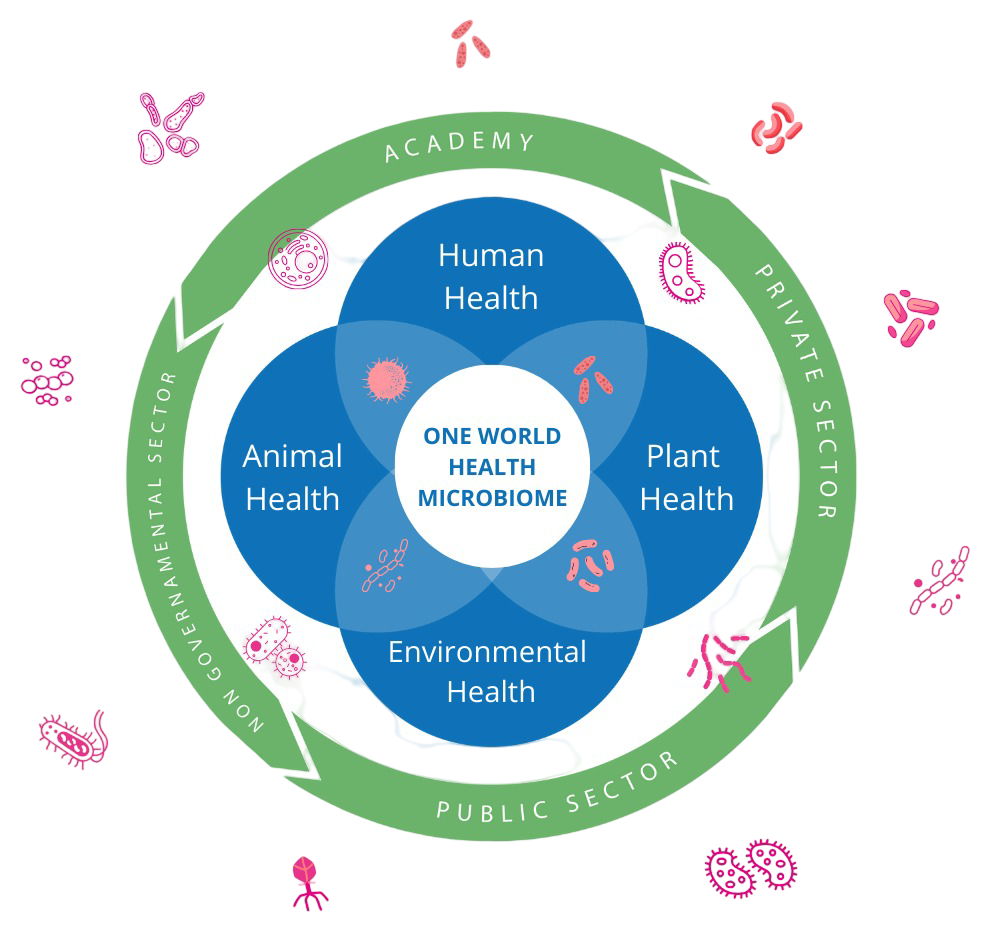
One Health approach, as defined by the Quadripartite (FAO/UNEP/WHO/WOAH), is an integrated, unifying approach that aims to sustainably balance and optimize the health of people, animals and ecosystems.
It recognizes that the health of humans, domestic and wild animals, plants, and the wider environment (including ecosystems) are closely linked and interdependent.
« The role of microbes in One Health approach is starting to be understood and we are at the dawn of this research journey”
Emmanuelle Soubeyrand WOAH during the kick-off meeting of the WMP initiative, Paris, June 2025
Strengthen microbiome research and collaborations
The World Microbiome Partnership brings together global stakeholders to unlock microbiome potential through science, standards, and One Health solutions.
The microbiome refers to the trillions of microorganisms—bacteria, viruses, fungi, and other microbes—that live in and on us, in our soils, oceans, and across all ecosystems on Earth.
gThe World Microbiome Partnership brings together global stakeholders to unlock microbiome potential through science, standards, and One Health solutions.
The microbiome refers to the trillions of microorganisms—bacteria, viruses, fungi, and other microbes—that live in and on us, in our soils, oceans, and across all ecosystems on Earth.
pThe World Microbiome Partnership brings together global stakeholders to unlock microbiome potential through science, standards, and One Health solutions.
The microbiome refers to the trillions of microorganisms—bacteria, viruses, fungi, and other microbes—that live in and on us, in our soils, oceans, and across all ecosystems on Earth.
hThe World Microbiome Partnership brings together global stakeholders to unlock microbiome potential through science, standards, and One Health solutions.
The microbiome refers to the trillions of microorganisms—bacteria, viruses, fungi, and other microbes—that live in and on us, in our soils, oceans, and across all ecosystems on Earth.
tThe World Microbiome Partnership brings together global stakeholders to unlock microbiome potential through science, standards, and One Health solutions.
The microbiome refers to the trillions of microorganisms—bacteria, virusess, fungi, and other microbes—that live in and on us, in our soils, oceans, and across all ecosystems on Earth.